
Electrochemically Induced Direct Air Capture With Engineered Aqueous Flow Systems
1 October 2026
Affiliation
NUS
Focus topic
CO2 Capture
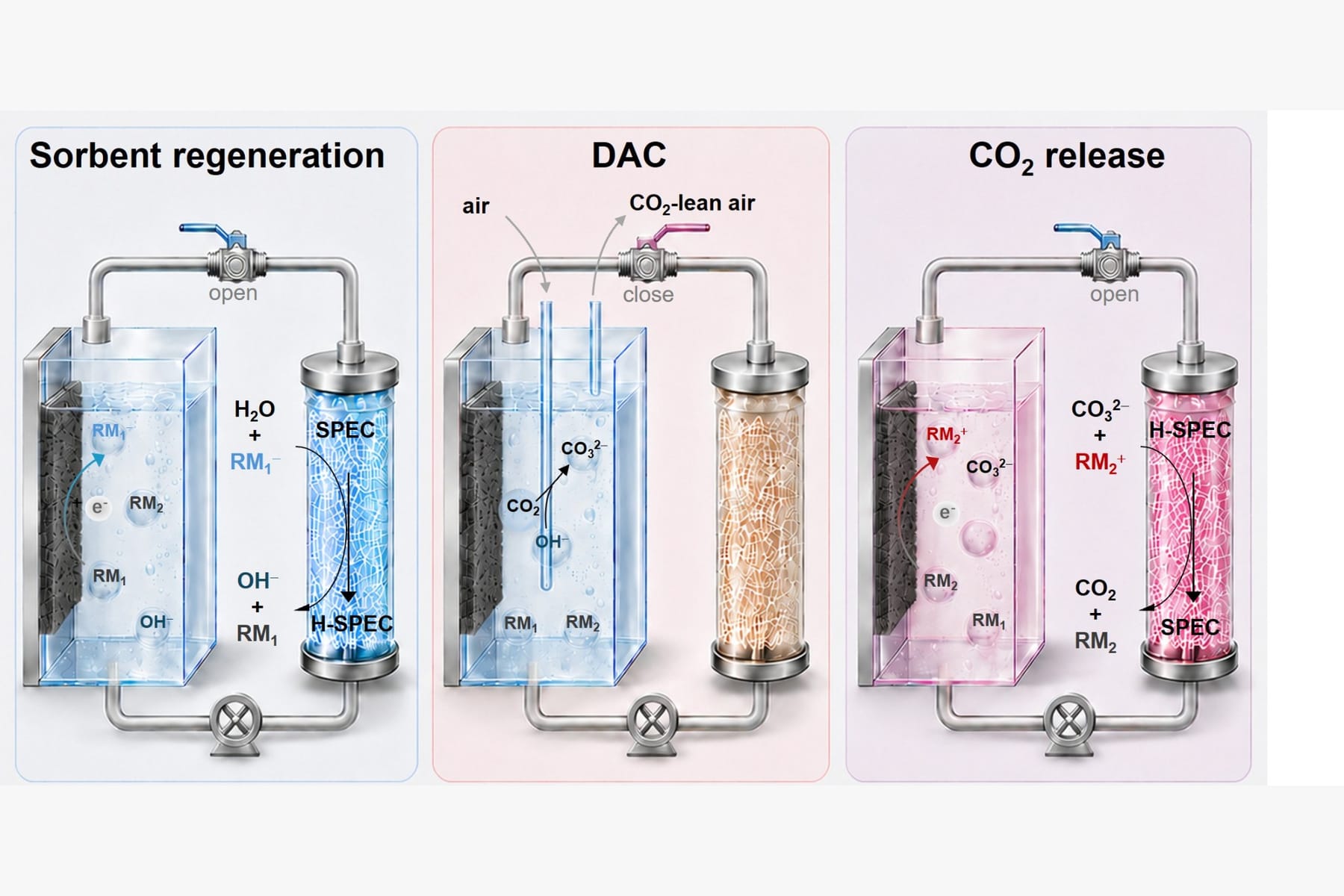
Electrochemically induced direct air capture via a redox-mediated aqueous flow system incorporating a solid proton-electron carrier
Summary
A redox-mediated aqueous flow system that demonstrated 21 days of continuous operation over seven cycles, with an average CO2 capture volume of 38.6 mL per cycle and 99.9% Coulombic efficiency.
The optimized system delivered a CO2/e⁻ ratio of 0.54, energy consumption of 175.8 kJ mol-1 CO2, 41% capture efficiency, 97% release yield, and 98 vol% CO2 purity. Preliminary techno-economic analysis estimated a levelized capture cost of $135.60 per tonne of CO2.
What makes this novel compared to best-in-class technology?
Unlike best-in-class electrochemical DAC systems, this architecture physically isolates the oxygen-sensitive proton–electron carrier from air, maintains >99.9% Coulombic efficiency, delivers a 9.2-fold capacity increase without changing electrolyte volume or composition, and releases CO₂ off-electrode in a packed bed, avoiding bubble-induced electrochemical interference.
TRL Level
1-3
Relevant for
Direct-air-capture plant developers and operators; modular DAC facilities powered by low-carbon electricity; carbon-removal hubs co-located with CO₂ compression, transport, geological storage, or utilisation infrastructure
About

Inventors: Yan Jing, Gowri Mohandass, Sheng Xu, Kaiping Zhu
Affiliation: National University of Singapore (NUS), Department of Materials Science and Engineering
Publication: S. Xu, K. Zhu, Z. Wei, G. Mohandass, H. Sun, Z. Chen, Y. Jing, Electrochemically induced direct air capture via a redox-mediated aqueous flow system incorporating a solid proton-electron carrier. Joule, 2026, 10.1016/j.joule.2026.102544.
Contact NUS for licensing opportunities and more information.
Please quote ID ref [2024-145] in your email.