
CO₂-Enabled Voltage Boosting in Redox Flow Batteries With Integrated Carbon Capture
1 October 2026
Affiliation
NUS
Focus topic
CO2 Capture
Energy Storage
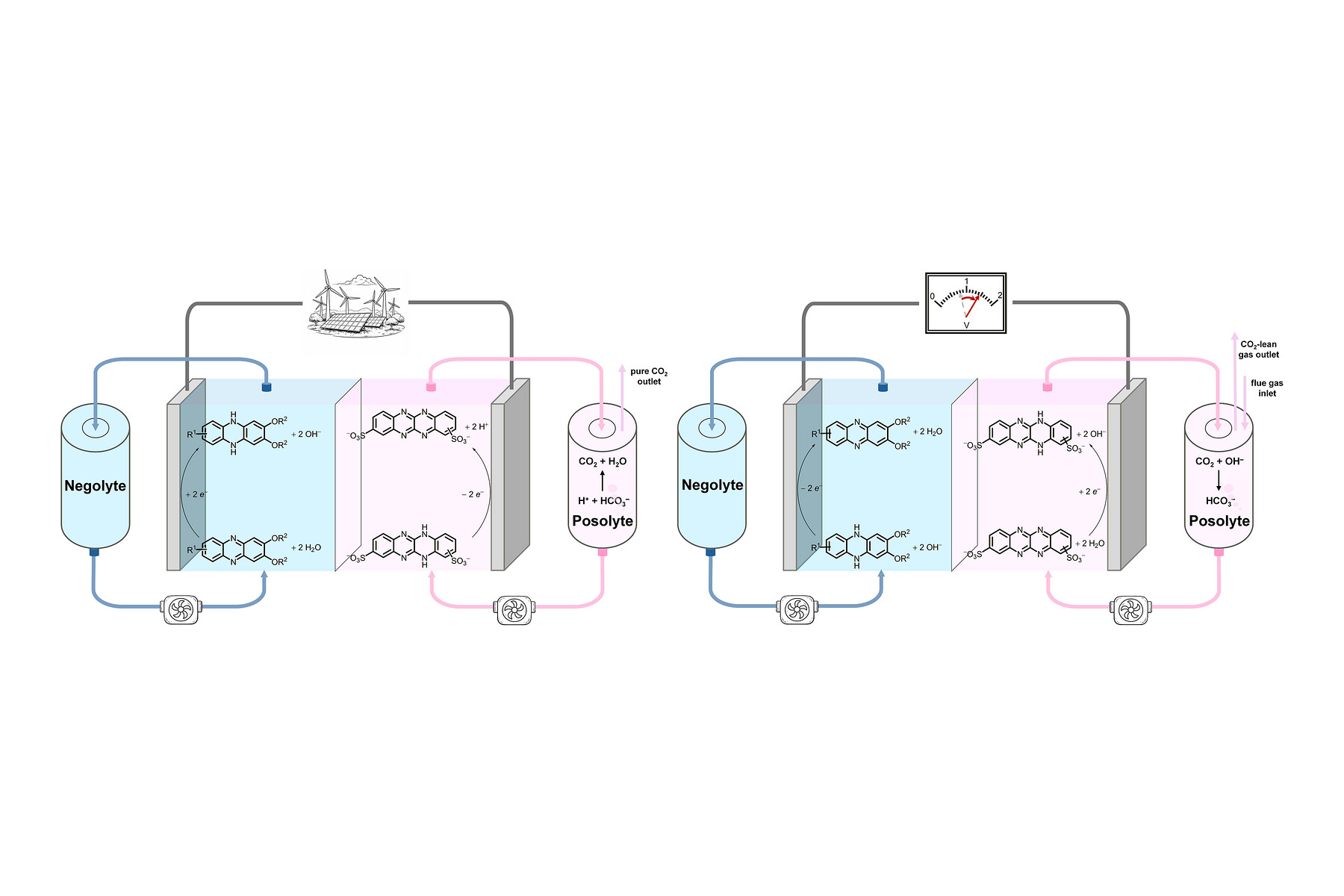
Energy-Enhanced Aqueous Organic Flow Batteries Enabled by Integrated Proton-Coupled Electron Transfer-Induced Carbon Capture and Utilization
Summary
Aqueous organic redox flow batteries offer a safe, scalable, and potentially cost-effective solution for storing massive electricity from intermittent renewables. Meanwhile, operating at ambient temperature and pressure, electrochemically induced carbon capture using aqueous redox sorbents in flow systems has recently emerged as a low-energy technology for climate change mitigation. Integrating these two technologies within an aqueous organic flow system represents a unified route to achieving decarbonisation.
This laboratory-scale, all-organic aqueous flow battery integrates energy storage with reversible CO2 capture from simulated flue gas containing 10% CO2 and 10% O2. The system maintained stable voltage enhancement over 100 charge–discharge cycles, with >99% Coulombic efficiency and operation at 10–60 mA cm⁻2. Reversible CO₂ capture approached the theoretical limit, with a CO2/e⁻ ratio near 1 and an energy cost as low as 30.65 kJ mol⁻1 CO2. Capturing CO2 from simulated flue gas and releasing it as pure CO2 required 36.55–44.34 kJ mol⁻1.
A higher-voltage system achieved a peak power density of 134.3 mW cm⁻2, approximately three times that under N2, with capacity fade rates of 0.59% day⁻¹ and 0.05% cycle⁻1. CO2-induced electrolyte buffering increased the open-circuit voltage to 1.32 V and enhanced discharge energy output by up to 24.3% compared with operation under N2, while achieving a 73.9% round-trip energy efficiency.
As a proof-of-concept, our work establishes a new paradigm for integrating enhanced energy storage with carbon capture, utilization, and storage, paving the way for next-generation multifunctional electrochemical redox flow systems.
What makes this novel compared to best-in-class technology?
Unlike existing integrated systems where CO2 capture typically penalizes battery performance, this all-organic flow battery uses CO2-induced buffering to increase discharge energy by up to 24.3%, while achieving near-unity CO2/e⁻ capture efficiency and only 30.65 kJ mol⁻¹ CO2 regeneration energy.
TRL Level
1-3
Relevant for
Industrial sites requiring both stationary energy storage and flue-gas CO2 capture, coal- or gas-fired power plants, cement, steel, refinery and petrochemical facilities, renewable-powered industrial microgrids, flow-battery and CCUS system integrators.
About

Inventors: Yan Jing, Kaiping Zhu
Affiliation: National University of Singapore (NUS), Department of Materials Science and Engineering
Publication: Zhu, S. Xu, X. Wang, Z. Wei, K. Yang, Z. Chen, X. Wang, B. Lu, X. Zhao, Y. Jing, Energy-enhanced aqueous organic flow batteries enabled by integrated proton-coupled electron transfer-induced carbon capture and utilization. Advanced Energy Materials, 2026, 10.1002/aenm.202506006.
Contact NUS for licensing opportunities and more information.
Please quote ID ref [2025-270] in your email.